THE BOOK / 2026
THE HEALTH ORDER.
How Medicine Became Geopolitics. 21 East Press, July 2026. Paperback and ebook.
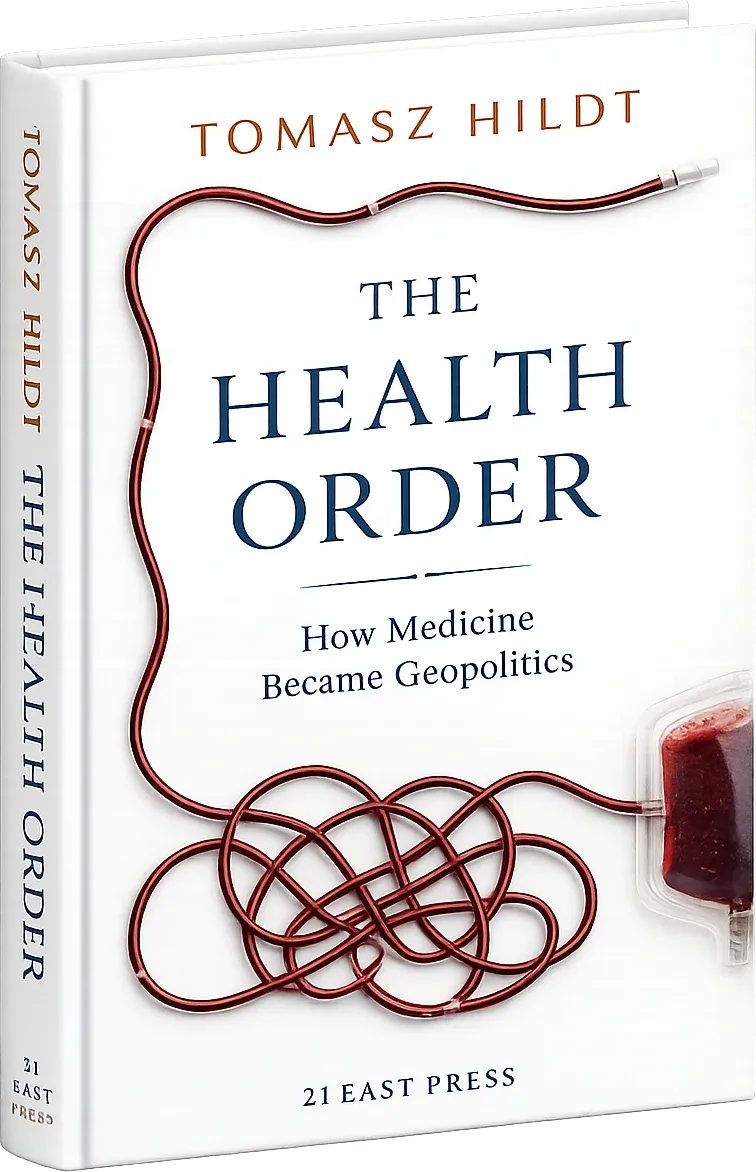
THE ARGUMENT
Medicine stopped being neutral a long time ago. We just kept pretending.
For most of the twentieth century, medicine was treated as the one domain that stood above politics - a shared human project, governed by science and administered by institutions that everyone agreed to trust. The Health Order argues that this was never quite true, and that in the last two decades it has stopped being true at all.
The book follows the money, the molecules and the rules. It traces how the manufacture of essential medicines concentrated in a handful of countries, how patents and regulatory approval became instruments of leverage between states, how pandemic preparedness turned into a negotiation over who owns pathogens and who owns the data, and how the gas in an MRI scanner or the insulin in a pharmacy became questions of national security.
It is not a book against the pharmaceutical industry, nor a defence of it. It is a map: who depends on whom, for what, and what happens to a country when the map changes and it discovers it cannot make, buy or regulate the medicines its population needs.
It is written for people who run institutions, advise governments, invest in health or teach the next generation to do any of these things - and for anyone who has noticed that the word “sovereignty” now appears in documents about supply chains, and wants to understand why.
INSIDE THE BOOK
- Introduction: Why I Wrote This Book
- Part One: The Illusion
- 01 The Molecule Is Not the Innovation
- 02 The Myth of Global Medicine
- 03 The Paper Power of Regulators
- 04 The Pandemic as an X-Ray
- Part Two: The Shift
- 05 The Desert Builds a Laboratory
- 06 Data Is the New Oil, But Blood Is the New Data
- 07 First-League Science, Third-League System
- 08 The Trade That Does Not Happen
- 09 The Patient as a Sovereign, or as Raw Material
- Part Three: The Reckoning
- 10 The Price of Life
- 11 Trust as Critical Infrastructure
- 12 The New Health Order
- Conclusion: The Question on the High Floor
- Notes
BUY
Ebook and paperback. Worldwide.
BOOKSHOPS
Paperback available to order through any bookshop worldwide via Ingram. Quote the ISBN.
ISBN 978-83-982455-1-7
EBOOK
EPUB edition for other readers.
ISBN 978-83-982455-0-0
FOR UNIVERSITIES
The book is already being taught. It was written to be argued with.
The Health Order is used in global health and international relations programmes as a text that students are expected to contest, not absorb. It sets out a position clearly enough to be disagreed with, and documents it well enough that the disagreement has to be serious.
Examination and review copies are available for course leaders and reviewers. Guest lectures and seminar sessions with the author can be arranged, in person in Europe and the Gulf or online.